How to Read Hemp Product Labels: What’s Really Inside Your Gummies and Oils?
Posted by Rare Cannabinoid Company on Oct 8th 2026
You’re browsing the wellness section of your local natural food store, looking at a dispensary shelf or comparing gummies online. One jar says “Sleep.” Another says “Mood.” A third promises “Calm.” Another puts “THCV” in big letters on the front.
How do you know what’s actually inside—and what that might mean for how you’ll feel?
The product name is a starting point, but it doesn’t tell you the complete formula. Two jars called “Sleep Gummies” can contain very different ingredients and amounts. One might contain CBD, another CBN, another a blend that includes THC. Others may contain melatonin, with or without cannabinoids.
To understand a hemp product, check the individual ingredients, the amount of each per serving, whether THC is included and a matching batch-specific lab report. A name or nighttime theme cannot predict your individual experience.
This guide walks you through those details, including how to find THC, CBC and CBD amounts on a real lab report. (Click to see Rare Cannabinoid Company's lab reports.)
“Mood” gummies and THC mints: check the blend and serving size
“Mood” is a product theme, not a standardized cannabinoid formula. One product may feature CBC and CBD, while another combines them with THC. Check the individual amounts and the type of THC rather than assuming that every Mood product contains the same ingredients.
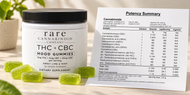
For a concrete label comparison, Rare Cannabinoid Company’s THC + CBC Mood Gummies list 5 mg delta-9 THC, 5 mg CBC and 25 mg CBD per gummy. Its THC + CBC Mood Mints list 2.5 mg delta-9 THC, 2.5 mg CBC and 12.5 mg CBD per mint.
These products feature the same three cannabinoids, but the stated amount per mint is half the amount per gummy. Comparing one piece with another without reading the quantities would miss that difference. Check the labeled serving definition as well: one piece and one serving are not always synonymous. For a price comparison, you'll also want to check the quantitiy per package. In this example, the THC + CBC Mood Gummies jar contains 30 gummies while the THC + CBC Mood Mints come in packets of 50 and jars of 120.
This is a formula comparison, not a promise that the products will feel identical. Format, quantity used and individual response also matter.
Not all “Sleep Gummies” contain the same ingredients
“Sleep Gummies” describes how a product is marketed. It does not identify a standardized recipe.
For example, the CBN Sleep Gummies and oils collection includes different formulas. Compare the individual product labels to distinguish options with THC from those labeled without it.
Start by turning the jar around or opening the complete ingredient information online. Does it list cannabidiol (CBD), cannabinol (CBN), THC, melatonin or a combination? CBN is often featured in nighttime cannabinoid products, but its presence and amount should be stated clearly rather than assumed from the product name.
| Ingredient or formula detail | What to look for on the label |
|---|---|
| CBD | The CBD amount per serving and any other cannabinoids included |
| CBN | The CBN amount per serving, rather than just a nighttime description |
| THC | The specific type, including delta-9 or delta-8 THC, and its amount per serving |
| Melatonin | Whether it is included and its stated amount; a cannabinoid COA does not establish melatonin content |
| A blend | A separate amount for each ingredient rather than only a combined total |
Will a nighttime gummy get you high?
The word “Sleep” does not answer that question. Check whether the formula includes THC, including delta-8 or delta-9 THC, and how much is in a serving. THC-containing products can produce a high; a product’s nighttime branding does not tell you whether THC is present or how you will respond.
A CBN label also does not mean the product is THC-free. Read the complete cannabinoid breakdown and confirm which THC compounds were tested on the lab report. Avoid assuming that a formula will feel a certain way simply because it highlights CBD, CBN or another cannabinoid.
The same principle applies to “Mood,” “Calm” and “THCV” products: the front tells you what the brand emphasizes; the detailed label tells you what the formula contains.
The hemp label checklist: seven things to check before buying
- Individual cannabinoid names: Which cannabinoids are actually included?
- Milligrams of each cannabinoid: Are amounts listed separately or only as a combined total?
- Serving size: Does one serving mean one gummy, two mints or a measured volume of oil?
- Servings per container: How many servings does the package contain?
- THC details: Does the formula include delta-8 THC, delta-9 THC or another explicitly identified ingredient?
- Complete ingredients: What else is included, such as carrier oils, sweeteners and flavorings?
- Matching lab report: Does the certificate of analysis identify the finished product and its batch?
If any of these details are unclear, ask the seller before purchasing. A clear explanation should connect the label, the product page and the lab report.
Read beyond the product name and featured cannabinoid
Front labels help you identify a product quickly, but they may emphasize a theme or just one component of a blend. “THCV gummies” does not automatically mean THCV-only gummies. Likewise, a product described as “CBG gummies” may also contain CBD or THC.
A blend can be clearly and accurately labeled. The important question is whether the shopper can identify every included cannabinoid and its amount without having to guess.
Read the side or back panel and the product description. Look for a breakdown such as “10 mg THCV + 20 mg CBD per gummy,” rather than relying solely on the largest word on the package.
THC and THCV are not the same
THC and THCV are different cannabinoids. THC stands for tetrahydrocannabinol; THCV stands for tetrahydrocannabivarin. The similar names do not mean they have the same effects.
Delta-9 THC is the cannabinoid most commonly associated with the cannabis high. It is also used for phyiscal relief, relaxation, and may increase hunger. Delta-8 THC is also intoxicating. THCV has a different chemical structure and a different research profile. In fact, THCV may increase energy and focus while decreasing hunger.
That distinction matters when shopping. A gummy labeled “THCV” may still get you high if it also contains THC. Read the amount of THCV separately from delta-8 or delta-9 THC rather than assuming the highlighted cannabinoid tells the whole story.
For example, a hypothetical gummy containing 5 mg THCV and 20 mg delta-9 THC is a blend with substantially more delta-9 THC than THCV by weight. It should not be confused with a formula containing THCV and CBD without added THC or with only a low amount of added THC.
Shopping rule: Check each cannabinoid and its amount per serving. If you want to exclude THC, verify both the detailed formula and the relevant THC results on a matching lab report.
Why be cautious about products centered on delta-8 THC?
Delta-8 THC can occur naturally in very small amounts in hemp and other cannabis. However, the concentrated delta-8 used in commercial formulas is typically made by chemically converting hemp-derived CBD. A trace amount in a natural extract is different from a product built around a substantial amount of converted delta-8. [5]
The concern is not simply that a conversion occurred. The process can introduce unwanted reaction by-products and residual chemicals if it is not carefully controlled and the resulting ingredient is not adequately purified and tested. FDA has specifically raised concerns about potentially harmful chemicals and contaminants associated with delta-8 manufacturing. [5]
Other potentially dangerous converted cannabinoids include: HHC, HHC-P, HHC-O, HHCH and THC-O.
For shoppers who prefer nautral, plant-extracted THC, look for delta-9 THC as the primary intoxicating cannabinoid, with a clearly documented source and finished-product testing, rather than a formula centered on converted delta-8.
What does the 0.3% hemp statement mean?
The widely cited 2018 federal hemp definition uses no more than 0.3% delta-9 THC on a dry-weight basis. [6] This is a concentration threshold, not a 0.3 mg serving limit, and it does not establish that a finished product can be sold everywhere.
For comparison, the example COA later in this guide reports 0.144% delta-9 THC and 5.04 mg per 3.5 g serving. A percentage below 0.3% can still correspond to a measurable amount per serving.
Hemp definitions and finished-product requirements can change, and additional federal and state rules apply. Check the requirements in effect where the product is sold and shipped rather than relying only on a “below 0.3%” label statement.
2. Separate hemp extract milligrams from cannabinoid milligrams
“Hemp extract,” “CBD” and “total cannabinoids” describe different things. Their milligram numbers are not automatically comparable.
A label stating “1,000 mg hemp extract” identifies an amount of extract, but does not by itself establish that the extract contains 1,000 mg CBD. You still need an individual cannabinoid breakdown.
| Label wording | What it communicates | What to check next |
|---|---|---|
| 1,000 mg hemp extract | A stated amount of extract | How much of each cannabinoid is present? |
| 1,000 mg CBD per bottle | A stated bottle-wide CBD amount | What is the CBD amount per serving? |
| 1,000 mg total cannabinoids | A combined cannabinoid amount | Which cannabinoids make up the total? |
| 1,000 mg hemp seed oil | An amount of seed-derived oil | Is any cannabinoid ingredient separately included? |
Large numbers can be eye-catching. Before comparing them, identify exactly what the number measures and whether it applies to one serving or the entire package.
3. Understand hemp seed oil versus CBD oil
Hemp seed oil and CBD oil are different ingredients. Hemp seed oil comes from the seeds of the hemp plant. FDA explains that hemp seeds do not naturally contain CBD or THC, although trace amounts can be picked up through contact with other plant parts during harvesting and processing. [2]
A bottle of hemp seed oil is therefore not automatically a source of a stated CBD serving. To identify a CBD-containing product, look for CBD as a separately identified component, a clear amount and supporting laboratory results.
Hemp seed oil can also be used as a carrier in a formula that includes CBD. In that case, the carrier oil and the added cannabinoid should be understood separately.
The same principle applies to other carrier oils. An ingredient such as MCT oil describes part of the formula; it does not tell you the CBD, THCV or CBG content.
4. Calculate the amount per serving
The amount per serving is usually the most useful number for comparing products. Package-wide totals alone can hide differences in serving size and quantity.
Suppose a jar contains 30 gummies and lists 900 mg CBD per jar. If the CBD is distributed evenly, that works out to 30 mg CBD per gummy. If the label defines a serving as two gummies, the stated serving contains 60 mg CBD.
These are arithmetic examples, not suggestions for how much to use.
Amount per piece = container-wide cannabinoid amount ÷ number of pieces.
For a multi-cannabinoid formula, calculate each cannabinoid separately. A hypothetical jar with 30 gummies, 600 mg CBG and 300 mg CBD contains 20 mg CBG and 10 mg CBD per gummy, assuming even distribution.
For oils, check the measured volume
For a bottle with 900 mg CBD in 30 mL, the calculated concentration is 30 mg CBD per mL. A 0.5 mL serving would contain 15 mg CBD at that concentration.
Do not assume that “one dropper” always means 1 mL. Check the label's volume instructions and the markings on the supplied dropper. A drop and a dropper are also different quantities. This is the same with spray caps and other forms of delivery.
If the stated totals and serving amounts do not reconcile, ask the brand to explain the discrepancy.
5. Check THC separately from CBD and rare cannabinoids
CBD, CBG, CBC, CBN, CBDV and THCV should be individually identified rather than treated as interchangeable with THC. A combined cannabinoid total does not tell you whether THC is included.
Also distinguish percentage from amount per serving. A percentage describes a proportion; milligrams describe an amount. A percentage statement alone does not answer how many milligrams are in one gummy or measured serving.
For a simple hypothetical calculation, 0.1% by weight in a 5-gram gummy corresponds to 5 mg. This illustrates why percentage and serving information belong together; it is not a legal-compliance determination.
What about “THC-free” or “zero THC” wording?
Read any accompanying asterisk or explanation and check the lab report. Laboratories have measurement limits, so a result marked “not detected” is not proof of absolute zero.
Confirm which THC compounds were tested and what the laboratory's reporting limits mean. Clear wording should help you understand the result rather than leaving you to interpret a marketing phrase on its own.
6. Read a certificate of analysis, or COA
A certificate of analysis is a laboratory report describing results for a submitted sample. For shopping purposes, the most useful report corresponds to the finished product and its batch—not simply the raw ingredient used to make it.
NIST's cannabis measurement programs focus on improving laboratory measurement quality and comparability. That work underscores the importance of looking closely at what was measured and how results are reported. [3]
Match the report to the product
Check the product or sample name, batch or lot identifier, laboratory name and test date. Compare the report's batch identifier with the package when available. If it is not available before purchase, ask which batch the seller will provide.
A QR code is a convenient route to a report, but the presence of a QR code alone does not establish that the report matches the item.
Check units and the cannabinoid panel
Results may appear as milligrams per gram, milligrams per milliliter, percentage or milligrams per unit. Read the column headings before comparing laboratory values with the label.
For example, a measured 10 mg per gram in a 3-gram gummy corresponds to 30 mg per gummy. That conversion requires knowing the gummy's weight.
Look for the cannabinoid you are buying and the other cannabinoids you want to check. A compound omitted from the panel is not the same as a compound tested and reported as not detected.
Worked example: find THC, CBC and CBD per serving on a real report
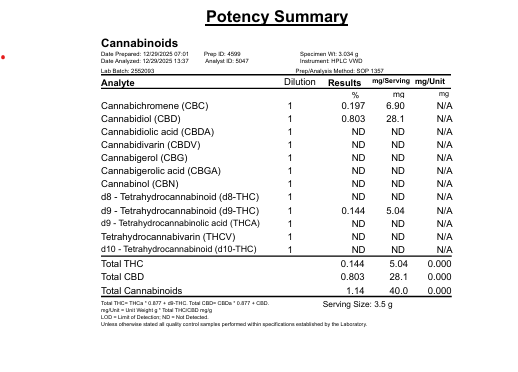
The accompanying TL Laboratories lab report, certificate T5L0831, identifies THC + CBC Mood Gummies with a stated formula of 5 mg delta-9 THC, 5 mg CBC and 25 mg CBD. This example describes that tested sample fro ma specific batch.
Place the supplied report image beside this walkthrough. Start in the lower half of the page at Potency Summary, then follow these four steps:
- Find the serving weight. Immediately below the cannabinoid table, the report states Serving Size: 3.5 g. Compare this with the package's serving definition. If one gummy is the labeled 3.5 g serving, the serving results below correspond to one gummy.
- Choose the correct column. Use mg/Serving, the column immediately to the right of Results %. These results are already expressed in milligrams per 3.5 g serving, so no multiplication is needed. Do not use the rightmost mg/Unit column: individual rows show N/A and the summary rows show 0.000, which should not be interpreted as zero cannabinoid content.
- Follow each cannabinoid's row across. CBC is the first row, CBD is the second, and delta-9 THC is farther down. Read across to mg/Serving.
- Check the totals. The Total THC and Total CBD rows near the bottom also report 5.04 mg and 28.1 mg per serving. CBC is shown on its own row. Do not add the individual THC or CBD result to its matching total; that would count the same amount twice.
| Cannabinoid | Where to look in Potency Summary | Reported mg per 3.5 g serving | Stated label amount | Difference from label |
|---|---|---|---|---|
| THC | delta-9 THC row; confirm with Total THC near the bottom | 5.04 mg | 5 mg | +0.8% |
| CBC | Cannabichromene (CBC), first row | 6.90 mg | 5 mg | +38.0% |
| CBD | Cannabidiol (CBD), second row; confirm with Total CBD near the bottom | 28.1 mg | 25 mg | +12.4% |
The Total Cannabinoids row reports 40.0 mg per serving. This is the combined total, rounded; it is not the amount of each cannabinoid. The three displayed individual values add to 40.04 mg.
How to compare a lab result with the label
Percentage difference = (measured amount − stated label amount) ÷ stated label amount × 100.
For THC in this example: (5.04 − 5) ÷ 5 × 100 = 0.8% above the label amount.
A laboratory result need not match the label to the last decimal place. Manufacturing and sample variation, rounding and laboratory measurement uncertainty can all contribute to differences. NIST's laboratory comparison work documents the importance of consistent cannabinoid measurements. [3] However, being plant-derived does not establish a particular acceptable percentage or explain a specific discrepancy by itself.
In this example, THC is within 1% of the stated amount, CBD is 12.4% higher and CBC is 38% higher. These are the observed differences, not a universal tolerance standard. The report alone does not explain why the values differ or provide a basis for saying that all three are within 10% or 20% of their label amounts.
Shoppers should compare each cannabinoid separately and ask the brand to clarify larger differences. A manufacturer's documented specification, any applicable requirements and the laboratory's measurement information are separate from the variation calculated here.
Understand laboratory abbreviations
| Term | General meaning | Why it matters |
|---|---|---|
| ND | Not detected under the laboratory's reporting convention | Does not establish absolute zero |
| LOD | Limit of detection | Describes a detection threshold |
| LOQ | Limit of quantification | Describes a threshold for reliably reporting an amount |
| mg/g | Milligrams per gram | Requires sample weight to calculate an amount per piece |
| mg/mL | Milligrams per milliliter | Requires measured volume to calculate an amount per serving |
Use the specific report's legend or ask the laboratory or brand for clarification, since reporting conventions vary.
Read the scope of testing
A cannabinoid report does not automatically mean the sample was also tested for metals, pesticides, residual solvents or microbiological contaminants. Check which panels are actually included.
Likewise, a “pass” result applies to the panel and criteria described in that report. It is not a blanket guarantee covering every aspect of the product.
7. Read the other ingredients and compare value fairly
Cannabinoid amounts are one part of the label. Read the remaining ingredients for carrier oils, sweeteners, flavorings, colors and any relevant allergen information. Check a vegan or other dietary designation separately rather than assuming it from the product format.
For price comparisons, start with the same cannabinoid and a comparable formula. A low-priced bottle of hemp seed oil is not a like-for-like substitute for a bottle with a verified CBD amount.
Two useful calculations are:
- Price per serving = product price ÷ number of labeled servings.
- Price per milligram of a specific cannabinoid = product price ÷ total milligrams of that cannabinoid.
Neither calculation is a complete quality assessment. Consider ingredient transparency, matching lab reports, packaging and the clarity of the seller's information alongside price.
What about hemp products on Amazon and other marketplaces?
Finding a product in search results for “CBD gummies” does not establish that the product contains CBD. Search placement, reviews and broad “hemp” wording are not substitutes for a specific formula and a matching COA.
In a 2024 investigation, CBD Oracle purchased 56 Amazon hemp products and arranged laboratory testing. Its results included CBD in 30% of the tested products. This was a specific historical sample, not an assessment of every listing available today. [4]
The practical lesson is to verify the individual product rather than assume that every marketplace listing is accurate—or that every hemp product is misleading.
If a brand's own website shows additional cannabinoid information, confirm that it describes the exact same product and formula. A similar bottle or product name is not enough to establish a match.
Questions to ask a hemp brand before purchasing
- What is the amount of each cannabinoid per gummy, mint or measured serving?
- Does the product contain delta-8 THC or delta-9 THC?
- Does the large number on the package refer to extract, one cannabinoid or combined cannabinoids?
- Can you provide a COA for the finished product and the batch being sold?
- Which cannabinoids and other panels were tested?
- How does the lab report's result translate into the amount per serving?
At Rare Cannabinoid Company, we encourage shoppers to compare the complete formula, individual cannabinoid amounts and available third-party lab reports before selecting a product. Whether you are considering a single cannabinoid or a blend, understanding the label helps you make a more informed comparison.
Frequently asked questions about hemp labels
Does “hemp” mean a product contains CBD?
No. Hemp seed oil, cannabinoid-containing extracts and other hemp-derived ingredients are different things. Check for a specific CBD amount and matching laboratory results.
Can THCV gummies also contain THC?
Yes. A formula marketed around THCV may include other cannabinoids, including THC. Read the detailed breakdown and COA rather than assuming the front label describes the entire formula.
Is THCV the same as THC?
No. THCV is a distinct cannabinoid from delta-9 THC. Each should be identified separately when included in a formula.
Does “1,000 mg hemp extract” mean “1,000 mg CBD”?
Not necessarily. The extract amount alone does not establish its CBD content. Look for a separate CBD amount.
Is the amount on the front per serving or per container?
It depends on the label. Look for “per gummy,” “per serving” or “per bottle,” then confirm the serving size and number of servings.
Does “ND” mean absolutely no THC?
No. It means the laboratory did not detect the tested compound under its reporting convention. Check the reporting limits and which THC compounds were included.
Is a lab report for the hemp extract enough?
A raw-ingredient report can provide information about that ingredient, but it does not by itself verify the finished formula's amount per serving. Ask for the finished product's matching batch report.
Can I verify CBD content from an online listing alone?
A listing can state a CBD amount, but a matching lab report provides additional evidence. Vague “hemp” wording or a large unspecified milligram number does not establish CBD content.